Sons of David Foundation on Paulownia

Thursday, June 12, 2008

Micropropagation Technique May Speed Reforestation Efforts

Agricultural Research, Dec, 2004 by Jan Suzkwi

Reforestation efforts may get a lift thanks to a new advance in plant-tissue culturing at ARS's National Center for Agricultural Utilization Research, Peoria, Illinois. Plant physiologist Brent Tisserat has devised an automated plant culture system (APCS), coupled with enhanced CO2 treatments that bolsters yield and survival of delicate shoots.

In reforestry operations, budding shoots are cultured inside small glass tubes or in Magenta vessels and nourished on an agar gel. Tissue culturists treat these shoots, originally derived from leaves, with growth regulators to coax them into multiplying secondary shoots. Transplanted to soil, these shoots eventually root and become whole, free-living plantlets that can then be put in the field.

With this technique, known as micropropagation, forest-product companies can restock plantations with millions of genetically identical tree plantlets. The yield of trees clonally derived from these plantlets is much more predictable than that from fertilized seed, says Tisserat.

Even so, not all micropropagated shoots survive transplanting--especially "vitrified" shoots, the source of axillary branches that do not readily root. In contrast, nonvitrified shoots readily form roots but produce few axillary branches.

The standard approach to solving yield problems would have involved tweaking the agar medium's nutritional composition. But Tisserat changed the way nutrient medium is applied to the shoots, modified the physical environment in which they are grown, and switched from Magenta vessels to larger growth chambers, which provide the tender shoots with much more space and media.

Tisserat's APCS uses an automated pump to microirrigate the shoots with liquid medium piped in from a separate tank. The medium is applied and removed several times over a 24-hour period. In trials, this resulted in a 10-fold increase in shoot yields compared to traditional culture methods and a 14-fold increase in fresh weight.

The CO2 treatments resulted in a 94percent survival rate for transplanted shoots (including vitrified ones). The APCS also speeds seedling growth of loblolly pine, a chief lumber resource in the southeastern United States. Tisserat and co-investigators had earlier success micropropagating and rooting peas, lettuce, tomatoes, beans, and spearmint.

This research is part of Quality and Utilization of Agricultural Products, an ARS National Program (#306) described on the World Wide Web at www.nps.ars. usda.gov.

Brent Tisserat is in the USDA-ARS Fermentation Biotechnology Research Unit, National Center for Agricultural Utilization Research, 1815 University St., Peoria, IL 61604; phone (309) 681-6289, fax (309) 681-6427, e-mail tisserbh@ ncaur.usda.gov.

COPYRIGHT 2004 U.S. Government Printing Office

Saturday, June 7, 2008

About Paulownia From Wikipedia Encyclopedia


Paulownia: From Wikipedia, the free encyclopedia

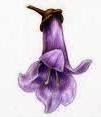
Paulownia is a genus of between 6–17 species (depending on taxonomic authority) of plants in the monogeneric family Paulowniaceae, related to and sometimes included in the Scrophulariaceae. They are native to much of China (its name in Chinese is pinyin: pàotóng), south to northern Laos and Vietnam, and long cultivated elsewhere in eastern Asia, notably in Japan and Korea. They are deciduous tree 10–25 m tall, with large leaves 15–40 cm across, arranged in opposite pairs on the stem. The flowers are produced in early spring on panicles 10–30 cm long, with a tubular purple corolla resembling a foxglove flower. The fruit is a dry capsule, containing thousands of minute seeds.

The genus was named in honour of Queen Anna Pavlovna of the Netherlands (1795–1865), daughter of Tsar Paul I of Russia.

Paulownia fortunei is a fast-growing tree that is grown commercially for the production of hardwood timber.

Paulownia tomentosa is listed as an invasive species in the southeastern United States, having been introduced there as an ornamental tree for its decorative flowers.

Uses

It is popular in its native China for reforestation, roadside planting and as an ornamental tree. It grows well in a wide variety of soil types, notably poor ones, but needs a lot of light and does not like a high water table. Paulownia timber is a pale whitish coloured wood with a straight grain. Its characteristics of rot resistance and a very high ignition point ensure the timber's popularity in the world market. Paulownia grown on plantations generally has widely spaced growth rings and is therefore much less valuable. The wood is also important in China, Korea, and Japan for making the soundboards of stringed musical instruments such as the guqin, pipa, koto, and kayagum.

Testing by CSIRO in Australia has shown that Paulownia wood is very attractive for wood-boring insects. Paulownia species are also used as food plants by the larvae of some Lepidoptera species including Endoclita excrescens.


Paulownia is known in Japanese as kiri, specifically referring to P. tomentosa; it is also known as the "princess tree". It was once customary to plant a Paulownia tree when a baby girl was born, and then to make it into a dresser as a wedding present when she gets married. Paulownia is the mon of the office of prime minister and also serves as the emblem of the cabinet and the government (vis-à-vis the chrysanthemum being the Imperial Seal of Japan). It is one of the suits in hanafuda, associated with the month of December. Japan: An Illustrated Encyclopedia (page 1189; Tokyo: Kodansha, 1993. ISBN 4-06-931098-3) states:

Paulownia wood is very light, fine-grained, soft, and warp-resistant and is used for chests, boxes, and clogs (geta). The wood is burned to make charcoal for sketching and powder for fireworks, the bark is made into a dye, and the leaves are used in vermicide preparations.

The fine grained soft and warp resistant properties also make Paulownia wood exceptionally suited for making wooden surfboards. Tom Wegener, Roy Stewart and more recently "Empress Surfboards" are amongst the shapers who pioneered its use. The resulting surfboards do not need to be glassed unlike Balsa wood.

More recently, it is used as body material for low-cost electric guitars and as the core for lightweight touring skis. It is often used in guitars as the core body, then finished with another kind of wood, such as the Dean ML XM that is made of paulownia as the body but is finished with mahogany.

Paulownia is extremely fast growing; some species of plantation Paulownia can be harvested for saw timber in as little as five years. Once the trees are harvested, they regenerate from their existing root systems, earning them the name of the “Phoenix tree." Paulownia has the ability to reclaim ecologically stressed and degenerate patches of land relatively quickly. Its root systems run deep and penetrate compacted and contaminated soils which have resulted from industrialized development. Paulownia is a phyto-remediator, increasing the organic content of degraded soils, processing and filtering contaminants through the uptake of its vascular system, and emitting oxygen into the atmosphere.

Paulownia Elongata


Paulownia elongata is a species of plant in the Paulowniaceae family. It is used as a forestry tree in North America and China. It is reportedly the fastest growing hardwood trees, which are known to grow up to 15 or more feet in the first year. Commercial plantations are normally established from selected clones resulting from micropropagation. Some proponents claim that P. elongata plantations can reach a harvestable size in five to seven years. Leaves are very large and pubescent. This species can withstand a very wide range of environmental conditions; however, it will not grow at altitude.

P. elongata has a number of uses:

  • An ornamental tree of parks and gardens; grown for its purple flowers and shade tolerance.
  • It is a forestry tree producing strong, yet light wood.
  • Owing to the large quantity of biomass produced annually, it is suited for use as a feedstock for biofuel production.
  • For more information on paulownia you may visit our website at www.paulownianow.org

Monday, June 2, 2008

Plant a Tree for Friendship – or Father’s Day

A tree is a gift given many times over. Not just the giving of the tree itself, but also the time spent planting it together, and years and years of enjoyment as it grows!

During the early years of Rotary International, its founder, Paul Harris, traveled the globe, fostering world peace and understanding. To create living memorials to these new friendships, he commemorated his visits by planting Friendship Trees. Harris planted approximately 50 Friendship Trees during his lifetime, many of which are still standing.

Planting a tree as a tribute is a great idea
. Because trees grow, add beauty, and enhance the environment for many years to come, they are ideal for commemorating love and friendship. And they make great gifts for those hard-to-buy-for family members. To select the right tree for your tribute, think about site conditions, your goals for the planting, and the species type that suits you aesthetically.

So, surprise Dad this year with something a little different

Sunday, June 1, 2008

Paulownia: The World’s Most Versatile Wood!


Most people know the Royal Empress Tree as the world’s fastest growing shade tree. Its extraordinarily fast growth (as much as ten feet per year) and beautiful springtime blooms have endeared this tree to many homeowners. However, this tree is also being grown commercially and people are starting to notice the incredible versatility of this wood.

Empress Tree wood is almost one third the weight of Oak and half the weight of Pine. Nevertheless, it has one of the highest strength to weight ratios of any wood. This makes it perfect for the manufacture of plywood, moldings, window frames and other building materials. Additionally, it’s ideal for industries that require high strength to weight ratios in products such as boats, surfboards, and RV’s.

Also, the tree’s high temperature resistance makes the wood extremely fire resistant. Consequently, it’s very desirable in your home. Ignition temperature is about 400 degrees Celsius, twice that of conventional woods.

Royal Empress (Paulownia) wood is also extremely stable. It is rot-resistant and won’t warp or crack. This makes it outstanding in the manufacture of furniture and handicrafts of all kinds.

The high consistency of sound radiation quality of Empress Tree wood also makes it highly prized in the production of musical instruments. Empress Trees are even used as animal feeds and for medicinal purposes!

There is seemingly no end to the high quality uses for the Royal Empress Tree, the world’s most versatile wood.